
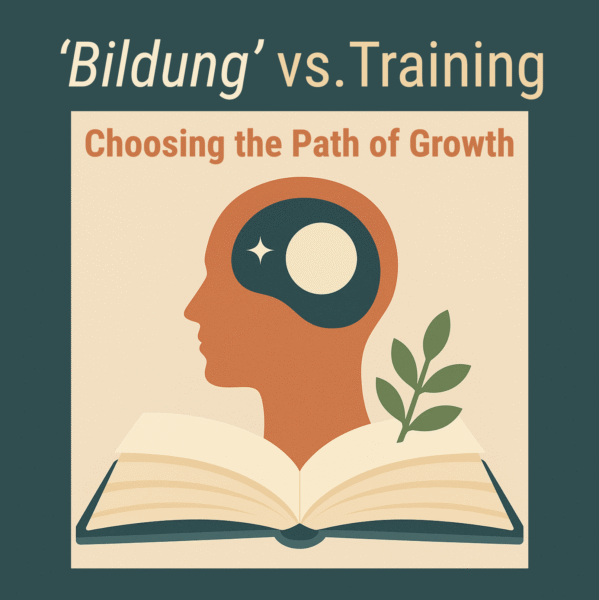
In English, the word education often feels utilitarian. We measure it in degrees, credentials, or skills that slot neatly into a job description. In our conversation this week, my lovely friend Trudy talked about a German word ‘Bildung’ and how this term offers something deeper and so ofcourse I wanted to look deeper into it. The term is rich and layered, and it doesn’t translate neatly into English. While it’s often rendered as ‘education,’ its meaning goes beyond schooling or vocational training. It connects to ideas of self-formation, cultivation, and personal growth; both intellectual and moral.
The term ‘Bildung’ resists translation, pointing instead to self-formation, the lifelong process of becoming, of shaping who we are in relation to the world around us.
It is not just about training the worker, but cultivating the human being. Wilhelm von Humboldt, one of the philosophers who gave the term its educational meaning, described it as the dialogue between self and world. Through literature, science, art, or civic life, we are not only absorbing knowledge but also discovering ourselves in relation to it.
As a design educator, I find this idea profoundly relevant to my own philosophy. My students often come to class anxious about assignments, deadlines, or grades, understandable, but also limiting if that becomes the only measure of their learning. What I try to emphasise, whether through slow reading exercises or weekly reflective blogging, is that design education isn’t just about mastering tools or producing polished projects. It’s about cultivating the habits of attention, reflection, and curiosity that will shape them as designers, and as people.
In this way, ‘Bildung’ gives me a vocabulary for what I already hope my classroom can be: a place where skills and critical thought meet, where students are encouraged to see themselves not only as future professionals but as participants in culture and society. To recognise themselves as designers is one thing; to recognise themselves as designers who are also citizens of a larger world is another.
Education should be open-ended, it should not be a checklist of competencies dictated by industry to prepare students primarily for the labor market. The most important outcomes may be the ones that can’t be graded: learning to see the world differently, finding one’s voice, connecting values to practice. These should not just by-products of design education; they should be at the heart of it. The key idea should be to foster critical citizens capable of sustaining democracy, peace, and cultural life, not mere machines that feed into the economic cog, serving profit over people.
____________________________________________
Some key insights into the term ‘Bildung’
Etymology: ‘Bildung’ comes from the word Bild [image, form]. Originally, it suggested ‘forming’ or ‘shaping’ oneself in the image of something higher, whether that be God, nature, or an ideal of humanity.
Philosophical roots: Enlightenment and Romantic thinkers such as Wilhelm von Humboldt, Hegel, and Goethe developed Bildung into a philosophical and educational idea. Humboldt in particular saw Bildung as the central aim of education: the development of the whole person.
